Thursday, February 27, 2014

8 Great Places in Rome: No 1 of 8

1 Pompeii

No visit to Rome would be complete without a day trip to Pompeii. The fastest way to get to Italy’s most popular attraction is to take the train from Rome to Naples and then the Circumvesuviana train route to the ancient site. Both train rides together may take two hours, but you would never forgive yourself if you didn’t visit it after being so nearby it. With either a guided tour or an audio tour, you can walk among the streets of this ruined metropolis to learn about its history and see what remains of 2,000 year old shops, restaurants, residential homes, baths and brothels as well as political, religious and commercial centers. There are also plastered body casts of actual people who died in the catastrophic volcanic eruption of 79 AD. The National Archeological Museum of Pompeii contains a fascinating collection of artifacts and art works that were excavated from the Pompeii site.

Read More...

Monday, February 24, 2014

8 Great Places in Rome: No 2nd of 8

2 Positano

If a brief retreat is in order to relax and rest up after all your sightseeing in Rome, Positano just may be the place. Located off the Amalfi Coast, Positano is a picturesque village of multi-colored houses and quiet, pebbled beaches. To reach this beautiful oasis, you can take a train from Rome to Salerno, followed by a ferry ride to Positano. Feel free to bask in the Mediterranean sun while lounging on the beautiful beaches of Fornillo or Spiaggia Grande, or explore the nearby mountains to see beautiful waterfalls and rare species of plants and animals. Don’t miss out on a visit to the Church of Santa Maria Assunta, which features lovely architecture and a Black Madonna icon that is steeped in local legend.

Read More ...

Sunday, February 23, 2014

8 Great Places in Rome: No 3rd of 8 Capri

3 Capri

A day trip from Rome to the beautiful island of Capri requires a full day, but it is well worth it. After a train ride from Rome to Naples, you then will enjoy a scenic boat ride across the Gulf of Naples to the main port of Capri, Marina Grande. At this lively port, you can browse a variety of shops, savor great food at a terraced cafe and watch people passing by as well as colorful boats coming in and out. Capri offers several fantastic attractions, but the one not to miss is the Blue Grotto, a cave that reveals a brilliant reflection of blue and emerald-colored water. The cave can be accessed by a short boat ride from Marina Grande. Other attractions include Mount Solaro, Capri’s highest point. A chair lift takes visitors to the top of the mountain which offers stunning views of the island and sea. The lovely Villa San Michele in the town of Anacapri is also worth a visit with its stunning gardens, Phoenician steps, cafe and museum.

Capri (/kəˈpr/; Italian pronunciation: [ˈkaːpri]) is an island in the Tyrrhenian Sea off the Sorrentine Peninsula, on the south side of the Gulf of Naples in the Campania region of Italy. The main town Capri on the island shares the name. It has been a resort since the time of the Roman Republic.
Features of the island are the Marina Piccola (the little harbour), the Belvedere of Tragara (a high panoramic promenade lined with villas), the limestone crags called sea stacks that project above the sea (the Faraglioni), the town of Anacapri, the Blue Grotto (Grotta Azzurra), and the ruins of the Imperial Roman villas.
Capri is part of the region of Campania, Province of Naples. The town of Capri is the island's main population centre. The island has two harbours, Marina Piccola and Marina Grande (the main port of the island). The separate comune of Anacapri is located high on the hills to the west.

Etymology

The etymology of the name Capri is unclear; it might either be traced back to the Ancient Greeks (Ancient Greek kapros meaning "wild boar"), the first recorded colonists to populate the island. But it could also derive from Latin capreae (goats). Fossils of wild boars have been discovered, lending credence to the "kapros" etymology, but on the other hand the Romans called Capri "goat island". Finally, there is also the possibility the name derives from an Etruscan word for "rocky", though any historical Etruscan rule of the island is disputed.
Capri is a large, limestone and sandstone rock. The sides of the island are perpendicular cliffs and the surface of the island is more cliffs.

Government

Edwin Cerio was mayor of Capri from 1920 to 1923. Although he was only three years in office, his vision and policies had far-reaching impact on the nature and role of the government on the island.
Italy is a Republic, thus Capri, as part of Italy, has adopted those same principles too. The voters of the island elect representatives for the two villages on the island. The chosen representatives then choose two mayors to govern with them.


Ancient and Roman times

Capri harbour from Anacapri
According to the Greek geographer Strabo, Capri was once part of the mainland. This has been confirmed by geological surveys and archaeological findings.
The city has been inhabited since early times. Evidence of human settlement was discovered during the Roman era; according to Suetonius, when the foundations for the villa of Augustus were being excavated, giant bones and 'weapons of stone' were discovered. The emperor ordered these to be displayed in the garden of his main residence, the Sea Palace. Modern excavations have shown that human presence on the island can be dated to the Neolithic and the Bronze Age. Augustus developed Capri; he built temples, villas, aqueducts, and planted gardens so he could enjoy his private paradise
In his Aeneid, Virgil states that the island had been populated by the Greek people of Teleboi, coming from the Ionian Islands. Strabo says that "in ancient times in Capri there were two towns, later reduced to one. Tacitus records that there were twelve Imperial villas in Capri (or Capreae, as it was spelled in Latin). Ruins of one at Tragara could still be seen in the 19th century.
Augustus' successor Tiberius built a series of villas at Capri, the most famous of which is the Villa Jovis, one of the best-preserved Roman villas in Italy. In 27 AD, Tiberius permanently moved to Capri, running the Empire from there until his death in 37 AD.
In 182 AD, Emperor Commodus banished his sister Lucilla to Capri. She was executed shortly afterwards.

Middle and Modern Ages

One of the symbols of Capri: the Blue Grotto
After the end of the Western Roman Empire, Capri returned to the status of a dominion of Naples, and suffered various attacks and ravages by pirates. In 866 Emperor Louis II gave the island to Amalfi. In 987 Pope John XV consecrated the first bishop of Capri.
In 1496 Frederick IV of Naples established legal and administrative parity between the settlements of Capri and Anacapri. The pirate raids reached their peak during the reign of Charles V: the famous Turkish admirals Barbarossa Hayreddin Pasha and Turgut Reis captured the island in 1535 and 1553 for the Ottoman Empire, respectively.
The first recorded tourist to visit the island was French antiques dealer Jean-Jacques Bouchard in the 17th century. His diary, found in 1850, is an important information source about Capri.

Recent history

In 1909–1911 Maxim Gorky lived on Capri at villa Behring (burgundy)
French troops under Napoleon occupied Capri in January 1806. The British ousted the French in the following May, after which Capri was turned into a powerful naval base (a "Second Gibraltar"), but the building program caused heavy damage to the archaeological sites. The French reconquered Capri in 1808, and remained there until the end of the Napoleonic era (1815), when Capri was returned to the Bourbon ruling house of Naples.
The natural scientist Ignazio Cerio catalogued Capri's flora and fauna during the 19th century. His work was continued by his son, author and engineer Edwin Cerio, who wrote several books on life in Capri in the 20th century.
Norman Douglas, Friedrich Alfred Krupp, Jacques d'Adelswärd-Fersen, Christian Wilhelm Allers, Emil von Behring, Curzio Malaparte, Axel Munthe, and Maxim Gorky are all reported to have owned a villa there, or to have stayed there for more than three months. Swedish Queen Victoria often stayed there. Rose O'Neill, the American illustrator and creator of the Kewpie, owned the Villa Narcissus, formerly owned by the famous Beaux Art painter Charles Caryl Coleman. Dame Gracie Fields also had a villa on the island, though her 1934 song "The Isle of Capri" was written by two Englishmen. Mariah Carey owns a villa on the island.
In 1908 Lenin was hosted by Maxim Gorky, the Russian author, at his house near the Giardini Augusto. In 1970 a monument by Giacomo Manzù was erected during the centennial celebration in Lenin's honour.
Today, Capri has become more of a resort and is invaded by tourists during the summer months of July and August

Thursday, February 20, 2014

8 Great Places in Rome: No 4th of 8 Villa d'Este

4 Villa d'Este

Villa d'Esteflickr/M.Maselli
If you enjoy formal gardens, Villa d’Este is a must-do. Located on the opposite side of town from Hadrian’s Villa, this splendid estate features a lovely mansion, but it is the gardens that most visitors come to see. What makes these historic gardens so special is the Renaissance method of integrating unique water works and artistic features into the beautiful landscape. Stroll along winding and maze-like paths that offer a pleasant surprise at every turn like musical fountains, gorgeous statues, frescoed rooms and breathtaking waterfalls. If you can tear yourself away from the gardens, you will also find cozy little restaurants and boutiques along the narrow streets of this charming villa.

History

Park of the Villa d'Este, Carl Blechen, 1830. The overgrown garden appealed to the Romantic imagination; today this same view is once again manicured
The Villa d'Este was commissioned by Cardinal Ippolito II d'Este, son of Alfonso I d'Este and Lucrezia Borgia and grandson of Pope Alexander VI. He had been appointed Governor of Tivoli by Pope Julius III, with the gift of the existing palace, which he had entirely reconstructed to plans of Pirro Ligorio carried out under the direction of the Ferrarese architect-engineer Alberto Galvani, court architect of the Este. The chief painter of the ambitious internal decoration was Livio Agresti from Forlì. From 1550 until his death in 1572, when the villa was nearing completion, Cardinal d'Este created a palatial setting surrounded by a spectacular terraced garden in the late-Renaissance mannerist style, which took advantage of the dramatic slope but required innovations in bringing a sufficient water supply, which was employed in cascades, water tanks, troughs and pools, water jets and fountains, giochi d'acqua. The result is one of the series of great 17th century villas with water-play structures in the hills surrounding the Roman Campagna, such as the Villa Lante, the Villa Farnese at Caprarola and the Villas Aldobrandini and Torlonia in Frascati. Their garden planning and their water features were imitated in the next two centuries from Portugal to Poland.
Drawing inspiration (and many statues and much of the marble used for construction) from the nearby Villa Adriana, the palatial retreat of Emperor Hadrian, and reviving Roman techniques of hydraulic engineering to supply water to a sequence of fountains, the cardinal created a fantasy garden. Its architectural elements and water features had an enormous influence on European landscape design.
Pirro Ligorio, who was responsible for the iconographic programs worked out in the villa's frescos, was also commissioned to lay out the gardens for the villa, with the assistance of Tommaso Chiruchi of Bologna, one of the most skilled hydraulic engineers of the sixteenth century; Chiruchi had worked on the fountains at Villa Lante. At Villa d'Este he was assisted in the technical designs for the fountains by a Frenchman, Claude Venard, who was a manufacturer of hydraulic organs.

The villa

The villa itself is surrounded on three sides by a sixteenth-century courtyard sited on the former Benedictine cloister. The fountain on a side wall, framed within a Doric, contains a sculpture of a sleeping nymph in a grotto guarded by d'Este heraldic eagles, with a bas-relief framed in apple boughs that links the villa to the Garden of the Hesperides.
The central main entrance leads to the Appartamento Vecchio ("Old Apartment") made for Ippolito d'Este, with its vaulted ceilings frescoed in secular allegories by Livio Agresti and his students, centered on the grand Sala, with its spectacular view down the main axis of the gardens, which fall away in a series of terraces. To the left and right are suites of rooms, that on the left containing Cardinal Ippolito's's library and his bedchamber with the chapel beyond, and the private stairs to the lower apartment, the Appartamento Nobile, which gives directly onto Pirro Ligorio's Gran Loggia straddling the gravelled terrace with a triumphal arch motif.

Gardens

The garden plan is laid out on a central axis with subsidiary cross-axes, refreshed by some five hundred jets in fountains, pools and water troughs. The water is supplied by the Aniene, which is partly diverted through the town, a distance of a kilometer, and, originally, by the Rivellese spring, which supplied a cistern under the villa's courtyard (now supplied by the Aniene too). The garden is now part of the Grandi Giardini Italiani.
The Villa's uppermost terrace ends in a balustraded balcony at the left end, with a sweeping view over the plain below. Symmetrical double flights of stairs flanking the central axis lead to the next garden terrace, with the Grotto of Diana, richly decorated with frescoes and pebble mosaic to one side and the central Fontana del Bicchierone ("Fountain of the Great Cup"), planned by Bernini in 1660, where water issues from a seemingly natural rock into a scrolling shell-like cup.

Wednesday, February 19, 2014

8 Great Places in Rome: No 5th of 8 Hadrian's Villa

5Hadrian's Villa


All it takes is a one-hour trip from Rome to the small town of Tivoli to experience two of the most spectacular sites in the Lazio region, Hadrian’s Villa and Villa d’Este. Many tourists like to combine both of these villas into one instead of two day trips from Rome. A history lover’s paradise, Hadrian’s Villa features an impressive, sprawling complex of 30 ancient Roman structures that were built during the second century by the Emperor Hadrian as a retreat from the busy capital of Rome. Here, visitors can enjoy a glimpse into the lavishness of ancient Rome when you walk among the 250 acres of marble pavements, palaces, theaters, libraries, baths, temples and private quarters that once housed royal guardsman, attendants and slaves.

History

The villa was constructed at Tibur (modern-day Tivoli) as a retreat from Rome for Roman Emperor Hadrian during the second and third decades of the 2nd century AD. Hadrian was said to dislike the palace on the Palatine Hill in Rome, leading to the construction of the retreat. During the later years of his reign, he actually governed the empire from the villa. A large court therefore lived there permanently. The postal service kept it in contact with Rome 18 miles (29 km) away.
After Hadrian, the villa was used by his various successors. During the decline of the Roman Empire, the villa fell into disuse and was partially ruined. In the 16th century, Cardinal Ippolito II d'Este had much of the marble and statues in Hadrian's Villa removed to decorate his own Villa d'Este located nearby.

Structure and architecture

Hadrian's Villa was a complex of over 30 buildings, covering an area of at least 1 square kilometre (c. 250 acres) of which much is still unexcavated. The villa was the greatest Roman example of an Alexandrian garden, recreating a sacred landscape. The complex included palaces, severalthermae, theatre, temples, libraries, state rooms, and quarters for courtiers, praetorians, and slaves.

The ruins of Hadrian's Villa in their present state
The villa shows echoes of many different architectural orders, mostly Greek and Egyptian. Hadrian, a very well traveled emperor, borrowed these designs, such as the caryatids by the Canopus, along with the statues beside them depicting the Egyptian dwarf and fertility god, Bes. A Greek so called "Maritime Theatre" exhibits classical ionic style, whereas the domes of the main buildings as well as the Corinthian arches of the Canopus and Serapeum show clear Roman architecture.Hadrian's biography states that areas in the villa were named after places Hadrian saw during his travels. Only a few places mentioned in the biography can be accurately correlated with the present-day ruins.
One of the most striking and best preserved parts of the Villa are a pool and an artificial grotto which were named Canopus and Serapeum, respectively. Canopus was an Egyptian city where a temple (Serapeum) was dedicated to the god Serapis. However, the architecture is Greek influenced (typical in Roman architecture of the High and Late Empire) as seen in the Corinthian columns and the copies of famous Greek statues that surround the pool. One anecdote involves the Serapeum and its peculiarly-shaped dome. A prominent architect of the day, Apollodorus of Damascus, dismisses Hadrian's designs, comparing the dome on Serapeum to a "pumpkin". The full quote is "Go away and draw your pumpkins. You know nothing about these [architectural] matters." Once Hadrian became emperor, Apollodorus was exiled and later put to death.
An interesting structure in the villa is the so-called "Maritime Theatre". It consists of a round portico with a barrel vault supported by pillars. Inside the portico was a ring-shaped pool with a central island. During the ancient times, the island was connected to the portico by two drawbridges. On the island sits a small Roman house complete with an atrium, a library, a triclinium, and small baths. The area was probably used by the emperor as a retreat from the busy life at the court.
The villa utilizes numerous architectural styles and innovations. The domes of the steam baths have circular holes on the apex to allow steam to escape. This is reminiscent of the Pantheon, also built by Hadrian. The area has a network of underground tunnels. The tunnels were mostly used to transport servants and goods from one area to another.
In 1998, the remains of what archaeologists claimed to be the monumental tomb of Antinous, or a temple to him, were discovered at the Villa.

Tuesday, February 18, 2014

8 Great Places in Rome: No 6th of 8 Orvieto

6Orvieto is a city and comune in Province of Terni,
Orvietoflickr/Andy Hay
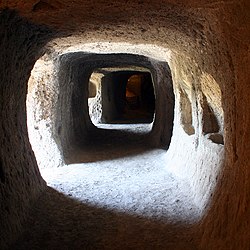
While in the Umbria region, you might also want to visit the charming town of Orvieto situated majestically on a big chunk of volcanic rock called tuff. Its impressive cathedral, the Duomo, which is considered one of Italy’s finest with its stunning mosaics and frescoes, influenced Michelangelo’s Sistine Chapel. It would certainly be well worth the time to explore the city’s labyrinth of underground tunnels. Carved 3,000 years ago from volcanic rock by the Etruscans to provide escape routes for the nobility, these elaborate tunnels contain grandiose rooms, stairs, cisterns and quarries. The city’s oldest church, San Giovenale, is also worth a visit as well as both the 14th century Albornoz Fortress and St. Patrick’s Well, which was uniquely designed to supply water for the city during war times.
Orvieto is a city and comune in Province of Terni, southwestern UmbriaItaly situated on the flat summit of a large butte of volcanic tuff. The site of the city is among the most dramatic in Europe, rising above the almost-vertical faces of tuff cliffs that are completed by defensive walls built of the same stone called Tufa.


History
Etruscan era
The ancient city (urbs vetus in Latin, whence "Orvieto"), populated since Etruscan times, has usually been associated with Etruscan Velzna, but some modern scholars differ. Orvieto was certainly a major centre of Etruscan civilization; the archaeological museum (Museo Claudio Faina e Museo Civico) houses some of the Etruscan artefacts that have been recovered in the immediate neighbourhood. An interesting survival that might show the complexity of ethnic relations in ancient Italy and how such relations could be peaceful, is the inscription on a tomb in the Orvieto Cannicella necropolis: mi aviles katacinas, "I am of Avile Katacina", with an Etruscan-Latin first name (Aulus) and a family name that is believed to be of Celtic ("Catacos") origin.

Roman and post-Roman eras

Orvieto was annexed by Rome in the third century BC. After the collapse of the Roman Empire its defensible site gained new importance: the episcopal seat was transferred from Bolsena, and the city was held by Goths and by Lombardsbefore its self-governing commune was established in the tenth century, in which consuls governed under a feudal oath of fealty to the bishop. Orvieto's relationship to the papacy has been a close one; in the tenth century Pope Benedict VIIvisited the city of Orvieto with his nephew, Filippo Alberici, who later settled there and became Consul of the city-state in 1016.

Middle Ages

Orvieto, sitting on its impregnable rock controlling the road between Florence and Rome where it crossed the Chiana, was a large town: its population numbered about 30,000 at the end of the 13th century. Its municipal institutions already recognized in a papal bull of 1157, from 1201 Orvieto governed itself through a podestà, who was as often as not the bishop, however, acting in concert with a military governor, the "captain of the people". In the 13th century bitter feuds divided the city, which was at the apogée of its wealth but found itself often at odds with the papacy, even under interdict. Pope Urban IV stayed at Orvieto in 1262-1264.
Some of the families traditionally associated with major roles in Orvieto’s history are: Monaldeschi, Filippeschi, Alberici and Gualterio, of whom only the Alberici and the Gualterio have survived to the present day.
The city became one of the major cultural centers of its time when Thomas Aquinas taught at the studium there. A small university (now part of the University of Perugia), had its origins in a studium generale that was granted to the city byPope Gregory XI in 1736. After teaching in Orvieto Aquinas was called to Rome in 1265 to serve as papal theologian to the newly elected Pope Clement IV, and as Regent master of the Santa Sabina studium provinciale, the forerunner of thePontifical University of Saint Thomas Aquinas, Angelicum.

Papal rule

The territory of Orvieto was under papal control long before it was officially added to the Papal States (various dates are quoted); it remained a papal possession until 1860, when it was annexed to unified Italy
.

Monday, February 17, 2014

8 Great Places in Rome: No 7th of 8

7Assisi
Assisiflickr/Roby Ferrari
A two-hour train ride from Rome to the lovely hill region of Umbria will bring you to the medieval town of Assisi where you can explore significant religious sites, Roman ruins and artistic beauty. The town’s main attraction is the Basilica of St. Francis, the eternal resting place of Italy’s patron saint. Most of the cobblestone streets in town lead to this beautiful cathedral where you can admire its exquisite architecture and interior ceilings and walls that are embellished with stunning frescoes. Surrounding the basilica, you will discover medieval houses and shops that are well worth a look. Other sites not to miss include Piazza del Comune, the town center, with its old clock tower, the Church of Santa Maria Sopra Minerva with its Roman columns, and St. Claire’s Basilica, which offers scenic views of the valley below.
Assisi (Italian pronunciation: [asˈsiːzi], from the Latin: Asisium) is a town and comune of Italy in the province of Perugia in the Umbria region, on the western flank of Monte Subasio.
It was the birthplace of St. Francis, who founded the Franciscan religious order in the town in 1208, and St. Clare (Chiara d'Offreducci), the founder of the Poor Sisters, which later became the Order of Poor Clares after her death. The 19th-century Saint Gabriel of Our Lady of Sorrows was also born in Assisi.

History

Around 1000 BC a wave of immigrants settled in the upper Tiber valley as far as the Adriatic Sea, and also in the neighborhood of Assisi. These were the Umbrians, living in small fortified settlements on high ground. From 450 BC these settlements were gradually taken over by the Etruscans. The Romans took control of central Italy by the Battle of Sentinum in 295 BC. They built the flourishing municipium Asisium on a series of terraces on Monte Subasio. Roman remains can still be found in Assisi: city walls, the forum (now Piazza del Comune), a theatre, an amphitheatre and the Temple of Minerva (now transformed into the Church of Santa Maria sopra Minerva). In 1997, the remains of a Roman villa were also discovered containing several well preserved rooms with frescoes and mosaics in a condition rarely found outside sites such as Pompei.
In 238 AD Assisi was converted to Christianity by bishop Rufino, who was martyred at Costano. According to tradition, his remains rest in the Cathedral Church of San Rufino in Assisi.
The Ostrogoths of king Totila destroyed most of the town in 545. Assisi then came under the rule of the Lombards as part of the Lombard and then Frankish Duchy of Spoleto.
The thriving commune became an independent Ghibelline commune in the 11th century. Constantly struggling with the Guelph Perugia, it was during one of those battles, the battle at Ponte San Giovanni, that Francesco di Bernardone, (Saint Francis of Assisi), was taken prisoner, setting in motion the events that eventually led him to live as a beggar, renounce the world and establish the Order of Friars Minor.
The city, which had remained within the confines of the Roman walls, began to expand outside these walls in the 13th century. In this period the city was under papal jurisdiction. The Rocca Maggiore, the imperial fortress on top of the hill above the city, which had been plundered by the people in 1189, was rebuilt in 1367 on orders of the papal legate, cardinal Gil de Albornoz.
In the beginning Assisi fell under the rule of Perugia and later under several despots, such as the soldier of fortune Biordo Michelotti, Gian Galeazzo Visconti and his successor Francesco I Sforza, dukes of Milan, Jacopo Piccinino andFederico II da Montefeltro, lord of Urbino. The city went into a deep decline through the plague of the Black Death in 1348.
The city came again under papal jurisdiction under the rule of Pope Pius II (1458–1464).

Temple of Minerva in the Piazza del Comune.
In 1569 construction was started of the Basilica of Santa Maria degli Angeli. During the Renaissance and in later centuries, the city continued to develop peacefully, as the 17th-century palazzi of the Bernabei and Giacobetti attest.
Now the site of many a pilgrimage, Assisi is linked in legend with its native son, St. Francis. The gentle saint founded the Franciscan order and shares honors with St. Catherine of Siena as the patron saint of Italy. He is remembered by many, even non-Christians, as a lover of nature (his preaching to an audience of birds is one of the legends of his life).
Assisi was hit by two devastating earthquakes, that shook Umbria in September 1997. But the recovery and restoration have been remarkable, although much remains to be done. Massive damage was caused to many historical sites, but the major attraction, the Basilica di San Francesco, reopened less than 2 years later.

Main sights

UNESCO World Heritage Site
Assisi, the Basilica of San Francesco and Other Franciscan Sites
Name as inscribed on the World Heritage List
Papal Basilica of St. Francis of Assisi.
TypeCultural
CriteriaI, II, III, IV, VI
Reference990
UNESCO regionEurope and North America
Inscription history
Inscription2000 (24th Session)
UNESCO collectively designated the Franciscan structures of Assisi as a World Heritage Site in 2000.

Churches

  • The Basilica of San Francesco d'Assisi (St. Francis). The Franciscan monastery, il Sacro Convento, and the lower and upper church (Italian: Basilica inferiore and Basilica superiore) of St Francis were begun immediately after his canonization in 1228, and completed in 1253. The lower church has frescoes by the late-medieval artists Cimabue and Giotto; the upper church houses frescoes of scenes in the life of St. Francis previously ascribed to Giotto, but now thought to be by artists of the circle of Pietro Cavallini from Rome. The Basilica was badly damaged by an earthquake on 26 September 1997, during which part of the vault collapsed, killing four people inside the church and carrying with it a fresco by Cimabue. The edifice was closed for two years for restoration.
  • Santa Maria Maggiore (St. Mary the Greater), the earliest extant church in Assisi.
  • The Cathedral of San Rufino (St. Rufinus), with a Romanesque façade with three rose windows and a 16th‑century interior; part of it is built on a Roman cistern.
  • Basilica of Santa Chiara (St. Clare) with its massive lateral buttresses, rose window, and simple Gothic interior, begun in 1257, contains the tomb of the namesake saint and 13th‑century frescoes and paintings.
  • Basilica of Santa Maria degli Angeli (St. Mary of the Angels), which houses the Porziuncola.
  • Chiesa Nuova, built over the presumed parental home of St. Francis
  • Santo Stefano, one of the oldest churches of Assisi.
  • Eremo delle Carceri, a small monastery with church at a canyon above the town, where St. Francis retreated and preached to birds
  • Church of San Pietro (St. Peter), built by the Benedictines in the 10th century and rebuilt in the 13th century. It has a rectangular façade with three rose windows; the Gothic chapel of the Holy Sacrament houses a triptych by Matteo di Gualdo.

Sunday, February 16, 2014

8 Great Places in Rome No 8th of 8


Planning a trip to Rome? Why not squeeze in some exciting day trips into your itinerary? Sure, Rome packs a treasure trove of attractions, but the beautiful regions around the bustling city offer some of the most spectacular scenery and interesting sites that you may not otherwise get the opportunity to experience. Check out the following day trips from Rome.

8Ostia Antica
Located at the mouth of the River Tiber, Ostia was Rome’s seaport, but, due to silting and a drop in sea level, the site now lies 3 kilometers (2 miles) from the sea. From Rome it takes about 45 minutes by metro and train to get to Ostia. The site is famous for the ancient apartment buildings (insula) that are very well preserved. You can explore these buildings to one story in height, with narrow stairways and corridors leading to small rooms. There are also the remains of more wealthy houses, such as the House of Cupid and Pysche, with very rich marble decorations.
Ostia Antica is a large archeological site, close to the modern suburb of Ostia (Rome), that was the location of the harbour city of ancient Rome, which is approximately 30 kilometres (19 miles) to the northeast. "Ostia" in Latin means "mouth". At the mouth of the River Tiber, Ostia was Rome's seaport, but due to silting the site now lies 3 kilometres (2 miles) from the sea. The site is noted for the excellent preservation of its ancient buildings, magnificent frescoes and impressive mosaics.

Origins

Ostia may have been Rome's first colonia. An inscription says that Ostia was founded by Ancus Marcius, the semi-legendary fourth king of Rome, in the 7th century BC. The oldest archaeological remains so far discovered date back to only the 4th century BC. The most ancient buildings currently visible are from the 3rd century BC, notably the Castrum (military camp); of a slightly later date is the Capitolium (temple of Jupiter, Juno and Minerva). The opus quadratum of the walls of the original castrum at Ostia provide important evidence for the building techniques that were employed in Roman urbanisation during the period of the Middle Republic.

Sacking by pirates

In 68 BC, the town was sacked by pirates. During the sack, the port was set on fire, the consular war fleet was destroyed, and two prominent senators were kidnapped. This attack caused such panic in Rome that Pompey the Great arranged for the tribune Aulus Gabinius to rise in the Roman Forum and propose a law, the Lex Gabinia, to allow Pompey to raise an army and destroy the pirates. Within a year, the pirates had been defeated.
The town was then re-built, and provided with protective walls by the statesman and orator Marcus Tullius Cicero.
  

Friday, February 14, 2014

Canals of Venice

1Canals of Venice
Referred to as “The City of Water”, Venice is the crown jewel of water cities. Romantic gondolas, and Italian architecture along the Grand Canal helped earn this status. Stitched together with over 150 canals that have become central to its character, Venice has decayed since its heyday and has more tourists than residents, but with its romantic charm it remains one of the top tourist attractions in Italy.
Venice is the capital of the Veneto region. In 2009, there were 270,098 people residing in Venice's comune (the population estimate of 272,000 inhabitants includes the population of the whole Comune of Venezia; around 60,000 in the historic city of Venice (Centro storico); 176,000 in Terraferma (the Mainland), mostly in the large frazioni of Mestre and Marghera; 31,000 live on other islands in the lagoon). Together with Padua and Treviso, the city is included in the Padua-Treviso-Venice Metropolitan Area (PATREVE), with a total population of 1,600,000. PATREVE is only a statistical metropolitan area without any degree of autonomy.
The name is derived from the ancient Veneti people who inhabited the region by the 10th century BC. The city historically was the capital of the Republic of Venice. Venice has been known as the "La Dominante", "Serenissima", "Queen of the Adriatic", "City of Water", "City of Masks", "City of Bridges", "The Floating City", and "City of Canals". Luigi Barzini described it in The New York Times as "undoubtedly the most beautiful city built by man". Venice has also been described by the Times Online as being one of Europe's most romantic cities.
The Republic of Venice was a major maritime power during the Middle Ages and Renaissance, and a staging area for the Crusades and the Battle of Lepanto, as well as a very important center of commerce (especially silk, grain, and spice) and art in the 13th century up to the end of the 17th century. This made Venice a wealthy city throughout most of its history. It is also known for its several important artistic movements, especially the Renaissance period. Venice has played an important role in the history of symphonic and operatic music, and it is the birthplace of Antonio Vivaldi.

Origins

Although there are no historical records that deal directly with the founding of Venice tradition and the available evidence have led several historians to agree that the original population of Venice consisted of refugees from Roman cities near Venice such as Padua, Aquileia, Treviso, Altino and Concordia (modern Portogruaro) and from the undefended countryside, who were fleeing successive waves of Germanic and Hun invasions. Some late Roman sources reveal the existence of fishermen on the islands in the original marshy lagoons. They were referred to as incolae lacunae ("lagoon dwellers"). The traditional founding is identified with the dedication of the first church, that of San Giacomo at the islet of Rialto (Rivoalto, "High Shore"), which is said to have been at the stroke of noon on 25 March 421.

Colosseum

Colosseum
Colosseumflickr/Brunswickian
The Colosseum in Rome is the largest and most famous amphitheater in the Roman world. Its construction was started by emperor Vespasian of the Flavian dynasty in 72 AD and was finished by his son Titus in 80 AD. The Colosseum was capable of holding some 50,000 spectators who could enter the building through no less than 80 entrances. Spectators were protected from the rain and heat of the sun by sails called the “velarium”, that was attached around the top of the attic.
The Colosseum or Coliseum, also known as the Flavian Amphitheatre (Latin: Amphitheatrum Flavium; Italian: Anfiteatro Flavio or Colosseo) is an elliptical amphitheatre in the centre of the city of Rome, Italy. Built of concrete and stone, it was the largest amphitheatre of the Roman Empire, and is considered one of the greatest works of Roman architecture and engineering. It is the largest amphitheatre in the world.
The Colosseum is situated just east of the Roman Forum. Construction began under the emperor Vespasian in 70 AD, and was completed in 80 AD under his successor and heir Titus. Further modifications were made during the reign of Domitian (81–96). These three emperors are known as the Flavian dynasty, and the amphitheatre was named in Latin for its association with their family name (Flavius).
The Colosseum could hold, it is estimated, between 50,000 and 80,000 spectators, and was used for gladiatorial contests and public spectacles such as mock sea battles, animal hunts, executions, re-enactments of famous battles, and dramas based on Classical mythology. The building ceased to be used for entertainment in the early medieval era. It was later reused for such purposes as housing, workshops, quarters for a religious order, a fortress, a quarry, and a Christian shrine.
Although in the 21st century it stays partially ruined because of damage caused by devastating earthquakes and stone-robbers, the Colosseum is an iconic symbol of Imperial Rome. It is one of Rome's most popular tourist attractions and has close connections with the Roman Catholic Church, as each Good Friday the Pope leads a torchlit "Way of the Cross" procession that starts in the area around the Colosseum.
The Colosseum, like all the Historic Centre of Rome, Properties of the Holy See in Italy and the Basilica of Saint Paul Outside the Walls, was listed as a World Heritage Site by UNESCO in 1980. In 2007 the complex was also included among the New7Wonders of the World, following a competition organized by New Open World Corporation (NOWC).
The Colosseum is also depicted on the Italian version of the five-cent euro coin.

History

Ancient


Sestertius of Titus celebrating the inauguration of the Colosseum (minted 80 AD).

A map of central Rome during the Roman Empire, with the Colosseum at the upper right corner
Construction of the Colosseum began under the rule of the Emperor Vespasian in around 70–72 AD, funded by the spoils taken from the Jewish Temple after the Siege of Jerusalem. The site chosen was a flat area on the floor of a low valley between the Caelian, Esquiline and Palatine Hills, through which a canalised stream ran. By the 2nd century BC the area was densely inhabited. It was devastated by the Great Fire of Rome in AD 64, following which Nero seized much of the area to add to his personal domain. He built the grandiose Domus Aurea on the site, in front of which he created an artificial lake surrounded by pavilions, gardens and porticoes. The existing Aqua Claudia aqueduct was extended to supply water to the area and the gigantic bronze Colossus of Nero was set up nearby at the entrance to the Domus Aurea.

Cross-section from theLexikon der gesamten Technik(1904)
Although the Colossus was preserved, much of the Domus Aurea was torn down. The lake was filled in and the land reused as the location for the new Flavian Amphitheatre. Gladiatorial schools and other support buildings were constructed nearby within the former grounds of the Domus Aurea. According to a reconstructed inscription found on the site, "the emperor Vespasian ordered this new amphitheatre to be erected from his general's share of the booty." This is thought to refer to the vast quantity of treasure seized by the Romans following their victory in the Great Jewish Revolt in 70 AD. The Colosseum can be thus interpreted as a great triumphal monument built in the Roman tradition of celebrating great victories, placating the Roman people instead of returning soldiers. Vespasian's decision to build the Colosseum on the site of Nero's lake can also be seen as a populist gesture of returning to the people an area of the city which Nero had appropriated for his own use. In contrast to many other amphitheatres, which were located on the outskirts of a city, the Colosseum was constructed in the city centre; in effect, placing it both literally and symbolically at the heart of Rome.
The Colosseum had been completed up to the third story by the time of Vespasian's death in 79. The top level was finished and the building inaugurated by his son, Titus, in 80. Dio Cassius recounts that over 9,000 wild animals were killed during the inaugural games of the amphitheatre. Commemorative coinage was issued celebrating the inauguration.
The building was remodelled further under Vespasian's younger son, the newly designated Emperor Domitian, who constructed the hypogeum, a series of underground tunnels used to house animals and slaves. He also added a gallery to the top of the Colosseum to increase its seating capacity.
In 217, the Colosseum was badly damaged by a major fire (caused by lightning, according to Dio Cassius which destroyed the wooden upper levels of the amphitheatre's interior. It was not fully repaired until about 240 and underwent further repairs in 250 or 252 and again in 320. An inscription records the restoration of various parts of the Colosseum under Theodosius II and Valentinian III (reigned 425–455), possibly to repair damage caused by a major earthquake in 443; more work followed in 484 and 508. The arena continued to be used for contests well into the 6th century, with gladiatorial fights last mentioned around 435. Animal hunts continued until at least 523, whenAnicius Maximus celebrated his consulship with some venationes, criticised by King Theodoric the Great for their high cost.

Medieval


Map of medieval Rome depicting the Colosseum
The Colosseum underwent several radical changes of use during the medieval period. By the late 6th century a small church had been built into the structure of the amphitheatre, though this apparently did not confer any particular religious significance on the building as a whole. The arena was converted into a cemetery. The numerous vaulted spaces in the arcades under the seating were converted into housing and workshops, and are recorded as still being rented out as late as the 12th century. Around 1200 the Frangipani family took over the Colosseum and fortified it, apparently using it as a castle.
Severe damage was inflicted on the Colosseum by the great earthquake in 1349, causing the outer south side, lying on a less stable alluvional terrain, to collapse. Much of the tumbled stone was reused to build palaces, churches, hospitals and other buildings elsewhere in Rome. A religious order moved into the northern third of the Colosseum in the mid-14th century and continued to inhabit it until as late as the early 19th century. The interior of the amphitheatre was extensively stripped of stone, which was reused elsewhere, or (in the case of the marble façade) was burned to make quicklime. The bronze clamps which held the stonework together were pried or hacked out of the walls, leaving numerous pockmarks which still scar the building today.

Modern


The Colosseum in a 1757 engraving byGiovanni Battista Piranesi
During the 16th and 17th century, Church officials sought a productive role for the Colosseum. Pope Sixtus V (1585–1590) planned to turn the building into a wool factory to provide employment for Rome's prostitutes, though this proposal fell through with his premature death. In 1671 Cardinal Altieri authorized its use for bullfights; a public outcry caused the idea to be hastily abandoned.
In 1749, Pope Benedict XIV endorsed the view that the Colosseum was a sacred site where early Christians had been martyred. He forbade the use of the Colosseum as a quarry and consecrated the building to the Passion of Christ and installedStations of the Cross, declaring it sanctified by the blood of the Christian martyrs who perished there (see Christians and the Colosseum). However there is no historical evidence to support Benedict's claim, nor is there even any evidence that anyone prior to the 16th century suggested this might be the case; the Catholic Encyclopedia concludes that there are no historical grounds for the supposition.
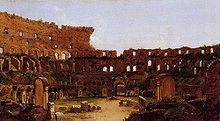
Interior of the Colosseum, Rome (1832) by Thomas Cole, showing the Stations of the Cross around the arena and the extensive vegetation
Later popes initiated various stabilization and restoration projects, removing the extensive vegetation which had overgrown the structure and threatened to damage it further. The façade was reinforced with triangular brick wedges in 1807 and 1827, and the interior was repaired in 1831, 1846 and in the 1930s. The arena substructure was partly excavated in 1810–1814 and 1874 and was fully exposed under Benito Mussolini in the 1930s.
The Colosseum is today one of Rome's most popular tourist attractions, receiving millions of visitors annually. The effects of pollution and general deterioration over time prompted a major restoration programme carried out between 1993 and 2000, at a cost of 40 billion Italian lire ($19.3m / €20.6m at 2000 prices).

The Colosseum today as a background to the busy metropolis
In recent years the Colosseum has become a symbol of the international campaign against capital punishment, which was abolished in Italy in 1948. Several anti–death penalty demonstrations took place in front of the Colosseum in 2000. Since that time, as a gesture against the death penalty, the local authorities of Rome change the color of the Colosseum's night time illumination from white to gold whenever a person condemned to the death penalty anywhere in the world gets their sentence commuted or is released, or if a jurisdiction abolishes the death penalty. Most recently, the Colosseum was illuminated in gold when capital punishment was abolished in the American state of New Mexico in April 2009.
Because of the ruined state of the interior, it is impractical to use the Colosseum to host large events; only a few hundred spectators can be accommodated in temporary seating. However, much larger concerts have been held just outside, using the Colosseum as a backdrop. Performers who have played at the Colosseum in recent years have included Ray Charles (May 2002), Paul McCartney (May 2003), Elton John (September 2005), and Billy Joel (July 2006).